Itxusuria
Legado en los huesosItxusuria is the traditional family burial place beneath the eaves of a Baztán Valley home, where children who died unbaptized were laid to rest. Its defining line is made by the roof’s drip: a strip between inside and outside, home and open ground. In the novel, that intimate boundary preserves generations of family grief and becomes the path by which a grave robber finds infant remains at Juanitaenea.
The House and Its Boundary
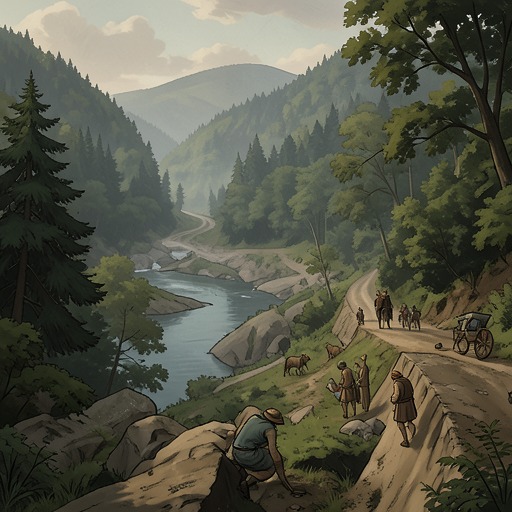
The Itxusuria is not a cemetery beside the house but a burial space at the house itself. Amaia Salazar realizes that in Baztán, unbaptized children were not necessarily buried by a wayside cross or outside a cemetery wall, as she had assumed. Their designated place could instead be the strip of ground marked by the eaves, where rainwater fell from the roof. The drip line made a visible and enduring boundary, separating the domestic interior from the world beyond while remaining part of the family’s own ground.
At Juanitaenea, the line had been traced by the slow fall of water for more than two hundred years. The custom therefore joins architecture, weather, and burial: the house’s roof marks the place, and repeated drops keep its boundary legible in the soil. When Amaia understands what the strip means, she recognizes that her family, like other families in the valley, may have buried its dead children there. The realization turns a local funerary practice into a discovery about the history held beneath her own family home.
The Children and Their Place in the Home
The buried children are described as members of the family, not as strangers placed beyond it. Amaia explains that their mothers honored them by leaving them at home as sentinels guarding the house. The Itxusuria thus gives a place within the domestic estate to infants who, because they died without baptism, did not have the ordinary place of the baptized dead. The custom holds together loss and belonging: the children are buried in the ground, yet remain understood as protectors of the household.
This practice sits alongside beliefs about the spiritual status of an unbaptized infant. The account of the Mairu-beso associates its supposed magical qualities with an infant who died before baptism and while still at the threshold between worlds. Folklore also imagined unbaptized children as remaining near their parents’ home, where they could protect the household. Families might preserve a dead child’s cradle or set a place for the child at the table; popular belief warned against giving the child’s name or clothes to a new sibling, but allowed that respectful treatment could make the child a source of joy and companionship. These beliefs are related to the Itxusuria’s household setting, though the burial custom and the Mairu-beso are not the same thing.
The Disturbed Ground at Juanitaenea
The Itxusuria becomes concrete when Amaia and Inspector Iriarte inspect the ground around Juanitaenea. James waits near the orchard with Ibai in his pram, having noticed a burial site; Amaia sends him home with the child and asks him not to alert her sisters or her aunt until they know more. In the softened earth, the investigators see mounds and holes, including a boot print whose edges are already blurring in the rain. One disturbed patch opens as if something had broken outward from underneath. Amaia finds a small skull, no larger than an apple, and nearby another hastily refilled hole with nothing visible inside it.
At the corner where the eaves leave their mark, dark infant bones show through the mud. Amaia recognizes that the old drip line has guided whoever disturbed the graves: the robber did not need to know every burial individually, only to follow the boundary the roof had made. She and Iriarte count at least nine test pits on one side of the house and as many on the other. During the continued inspection, they find three more skeletons in two holes. The remains are broken and badly deteriorated, while another burial contains a small bundle wrapped in waxed cloth and a fragment of crib blanket. The fabric makes the burial’s tenderness visible: a mother had wrapped her child before laying the child in the earth.
Family Memory, Evidence, and Restraint
The disturbed graves are not merely an archaeological find for Amaia. Kneeling in the wet soil, she sees the blanket as evidence of a mother’s care and imagines the grief of the woman who covered her child. The sight brings the pain of generations of women in her family close to the present. Her response becomes especially acute when she imagines having to lay Ibai in the same mud. The Itxusuria’s meaning is therefore carried not only by the bones but by the domestic objects and gestures around them: the eaves that mark the burial ground, the blanket that covered a baby, and the family home that has remained above the dead.
Amaia asks Iriarte not to have the burial ground excavated by Doctor San Martín’s team or turned into a press spectacle. She explains that the children are members of her family and asks that the family cemetery remain undisturbed in public view. She also suspects that the person behind the desecration of the Arizkun church has been plundering these graves; exposing the discovery might drive that person away before the investigation can identify them. Iriarte agrees that he would not permit his own family cemetery to be dug up. Amaia then continues the inspection, and when she finds the wrapped remains, she covers them again with the blanket and soil. Her decision balances the need to pursue the crime against a wish to protect the dead from becoming a spectacle.
From Burial Custom to Criminal Clue
The Itxusuria’s significance extends beyond Juanitaenea because infant remains could be sought for use as a Mairu-beso. The novel’s account of the belief stresses that the object had to come from a very young child who died unbaptized; an adult arm could not qualify, because the supposed power depended on infancy and the child’s passage between worlds. The investigation of church desecration therefore connects the violation of a family burial ground with the use of infant bones in a wider pattern of crime.
That connection also points toward the people involved. Doctor Berasategui’s plan is associated with the exploitation of the Itxusuria, while Esteban Yáñez, his father, is revealed to have found the family burial place and supplied bones to Antonio Garrido. The evidence does not make every disturbed grave or recovered bone identical, but it establishes the burial custom as a vulnerable source of remains and a crucial clue in the investigation. The Itxusuria is at once a place of familial care, a record of a local funerary tradition, and ground made legible to someone willing to turn its dead into instruments of desecration.